
A faster path from home assessment to home modification.
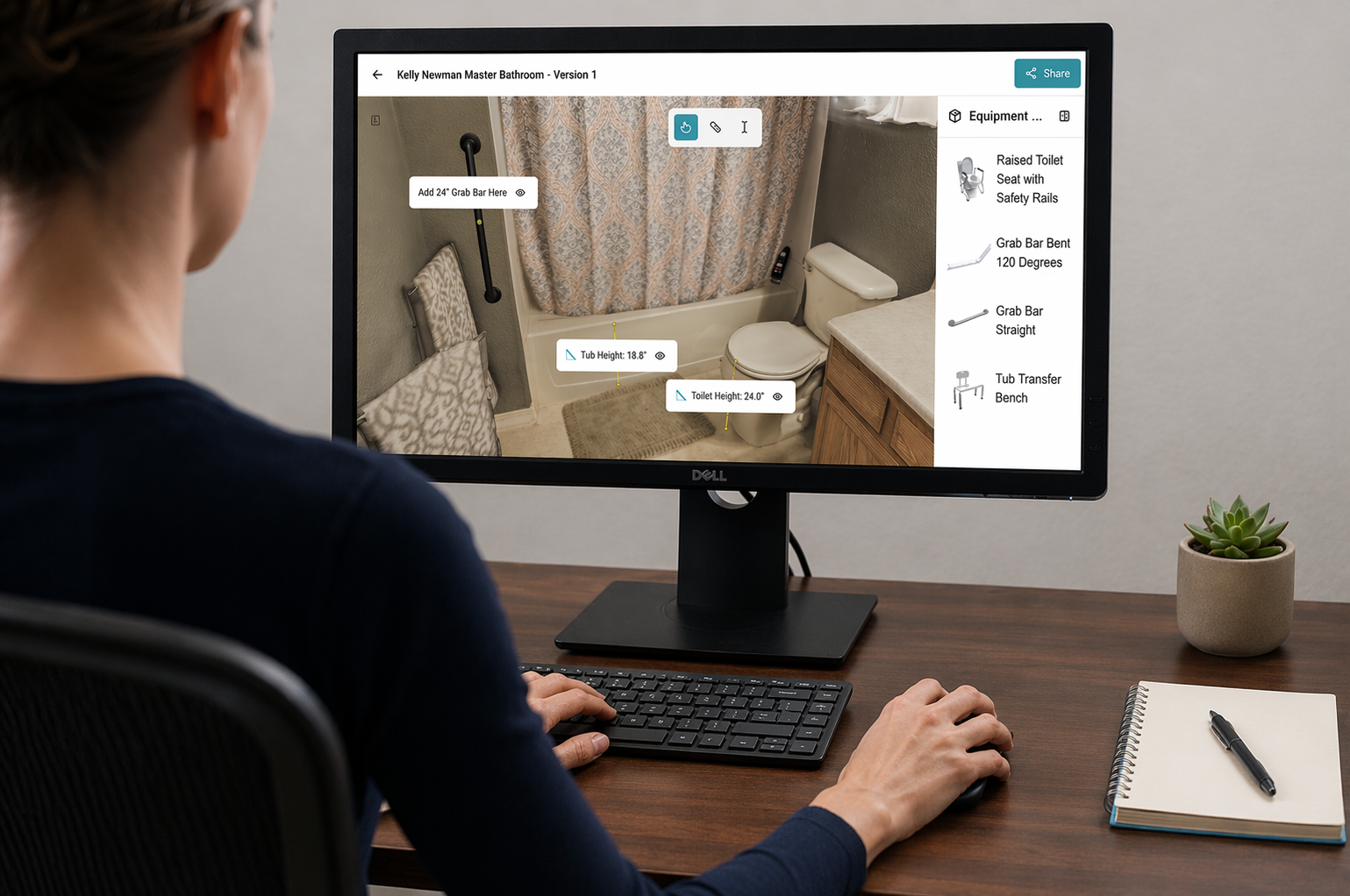
OmaScan is a 3D home assessment platform for healthcare and housing organizations. Your team captures scans on iPad, reviews them remotely, and coordinates everything downstream from a single shared record.
What a pilot would look like
A 60-day engagement with a defined scope and no obligation to continue.
Weeks 1 to 2
Workflow scoping
Map your current assessment process with your team and identify where OmaScan fits in.
Weeks 3 to 4
Setup and training
Account setup, template configuration, and training for your assessors and reviewers.
Weeks 5 to 8
Live assessments
Real assessments begin, with weekly check-ins and adjustments as the pilot reveals what's working.
After 60 days
Decide together
Review the data side by side. Scale up, adjust, or end the engagement with no further commitment.
Defined scope
Three to five assessors, an agreed assessment volume, and success metrics set together before the pilot starts.
Measurable outcomes
Anchored to metrics that matter to your team: referral-to-readiness time, share of OT time spent on clinical work, and the percentage of assessments completed without in-person travel.
No commitment beyond the pilot
If the data does not support scaling, the engagement ends at 60 days. No further obligation, no contract extension required.
Where assessments stall your work
In-person visits gate everything
Every assessment waits on a clinician driving to the home.
Virtual assessments are unreliable
Coaching a family over video works for some homes, not others, with no way to verify the result.
Assessment doesn't connect to action
Vendors, equipment orders, and contractor visits get coordinated over email and PDFs.
Documentation varies by assessor
Two OTs assessing the same home produce two different reports.
Clinical capacity is spent on logistics
OT time goes to travel and transcription, not clinical work.
Two ways OmaScan removes the bottleneck
When your assessor goes to the home
An OT captures the home in 3D in about five minutes. Any measurement they need later comes from the scan, not a return visit.
When the iPad goes instead
A family member, community technician, or home support worker captures the scan. Your clinical team reviews it remotely.
What changes for your team
Hospitals and health authorities
- Faster discharge for patients waiting on home assessments
- Documentation that matches your charting requirements
- Senior clinicians review from the office, no extra visits
Housing authorities and grant programs
- Faster grant cycle times, application to approved modification
- Documentation aligned with B651-18 and accessibility codes
- Contractor coordination from the same shared record
Home care and private practice
- More OT time on clinical work, less on travel
- New OTs running assessments confidently from week one
- Consistent documentation across every assessor
Supported by




Common questions
All scans, measurements, and patient identifiers are stored in AWS Canada (ca-central-1) and do not leave the country.
OmaScan is configured to meet PIPEDA federally, plus provincial frameworks including PHIPA, PHIA, Quebec Law 25, and ATIPPA where applicable.
Your organization owns the data. OmaScan processes it on your behalf under a data processing agreement that's part of every enterprise contract.
Every access, view, and modification is logged for your compliance and privacy teams.
PIA documentation is available on request for procurement and privacy office review.
For client-scanning workflows, OmaScan supports MDM-managed iPads so patient data stays off personal devices.
See if OmaScan fits your organization
A 15-minute call to walk through your current assessment workflow. We can talk about whether OmaScan would help, or where it wouldn’t, before scheduling anything more involved.
Book a discovery call